
Jonas G. Matt
PhD candidate
Automatic Control Laboratory (IfA), ETH Zürich
control theory · game theory · power systems
I am a second-year PhD candidate in Florian Dörfler’s group at the Automatic Control Laboratory (IfA) of ETH Zürich, with Saverio Bolognani and Giuseppe Belgioioso as additional mentors.
In my research, I aim to apply tools from control theory, game theory, and optimization to understand and shape the behavior of strategic agents in complex systems such as power grids. I am currently working on two main threads: developing “functional” incentive mechanisms for procuring control services (see here), and inverse optimization methods for learning agent behavior from observed decisions.
My previous work has ranged from controlling the continuum physics of soft robots to real-time voltage control in power grids. Outside academia, I have gained professional experience in data analytics, renewable energy systems, and IoT technologies.
If you would like to learn more about my work or are looking for open projects, have a look at the MAESTRO project.
news
-
Our IJRR paper Data-Driven Soft Robot Control via Adiabatic Spectral Submanifolds (paper) received an Honorable Mention for the IJRR Paper of the Season, as one of the top three papers published in April–June 2026.
-
Our paper Optimal Functional Incentives for Control (arXiv) has been accepted to CDC 2026. I am looking forward to presenting it in Hawaii in December!
-
Our paper From Droop to Optimality (doi) was accepted in Sustainable Energy, Grids and Networks. It shows how coordinated volt/var control lets existing grids host 10% more solar PV without new lines. Read more in the D-ITET news article.
-
Our paper on A Welfarist Perspective on Fair Generation Curtailment (arXiv) has been accepted to the 2026 PowerUp Conference in Boulder, CO. I am looking forward to meeting the global power systems community there in September.
selected publications
 Optimal Functional Incentives for Control: The Linear-Quadratic Case with Bilinear Incentives2026 IEEE Conference on Decision and Control (CDC), Dec 2026
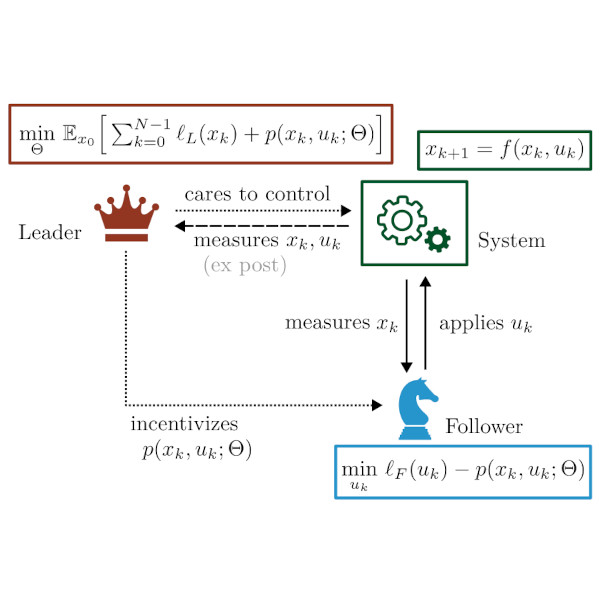
We study the design of functional incentive mechanisms for dynamical systems, in which a leader designs a fixed incentive function to motivate a self-interested follower to actuate the system beneficially over an extended horizon, without real-time revision of the incentive. This stands in contrast to the adaptive paradigm, in which the incentive is itself a continuously updated control variable. We formalize the problem as a discrete-time bi-level optimal control problem and derive analytical results for the linear-quadratic case with bilinear incentives and a myopic follower. Specifically, we establish a necessary and sufficient stability condition for the induced closed-loop system, derive a closed-form expression for the gradient of the expected leader cost with respect to the incentive parameter matrix, and obtain a fully closed-form cost expression in the scalar setting. Based on the latter, explicit characterizations of the optimal incentive parameter are provided in two asymptotic regimes: the infinite-horizon limit and the limit of high follower cost. For long horizons, the optimal incentive is shown to become independent of the follower’s private cost parameter, with direct implications for robust mechanism design under private information.
@inproceedings{mattOptimalFunctionalIncentives2026, title = {Optimal {{Functional Incentives}} for {{Control}}: {{The Linear-Quadratic Case}} with {{Bilinear Incentives}}}, shorttitle = {Optimal {{Functional Incentives}} for {{Control}}}, booktitle = {2026 {{IEEE Conference}} on {{Decision}} and {{Control}} ({{CDC}})}, author = {Matt, Jonas G. and Bolognani, Saverio and D{\"o}rfler, Florian}, year = {2026}, month = dec, eprint = {2604.27770}, primaryclass = {eess}, archiveprefix = {arXiv} }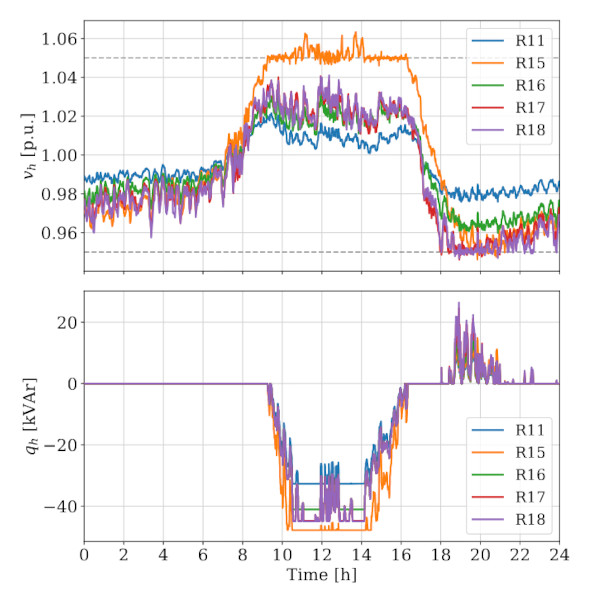 From Droop to Optimality: The Potential of Volt/Var Control for Power Distribution Grid EnhancementSustainable Energy, Grids and Networks, Sep 2026
When high amounts of active power are injected into power distribution grids, the overall power flow is limited because voltages reach their upper acceptable limits. Volt/var control aims to raise this power flow limit without physically reinforcing the grid but by controlling the voltage using reactive power. We use real consumption and generation data on a low-voltage CIGRÉ grid model and an experiment on a real distribution grid feeder to analyze how different volt/var methods can enhance the grid. We show that local droop control enhances the grid but underutilizes the reactive power resources. We discuss how this inefficiency can be partly reduced by fine-tuning the droop curves through data-driven techniques but illustrate that inherent trade-off persist for any local control method. We finally demonstrate that coordinated control methods can track the optimal solution and enhance the grid to its full potential if grid-wide communication is available. Our numerical study over a whole year of real data suggests that coordinated volt/var control can enable another 10.4% of maximum active power injections compared to droop control. In a small-scale real-life experiment, coordinated control enhanced the grid by the same amount.
@article{mattDroopOptimalityPotential2026, title = {From Droop to Optimality: The Potential of Volt/Var Control for Power Distribution Grid Enhancement}, author = {Matt, Jonas G. and Ortmann, Lukas and Bolognani, Saverio and D{\"o}rfler, Florian}, year = {2026}, month = sep, journal = {Sustainable Energy, Grids and Networks}, volume = {47}, pages = {102379}, issn = {2352-4677}, doi = {10.1016/j.segan.2026.102379} }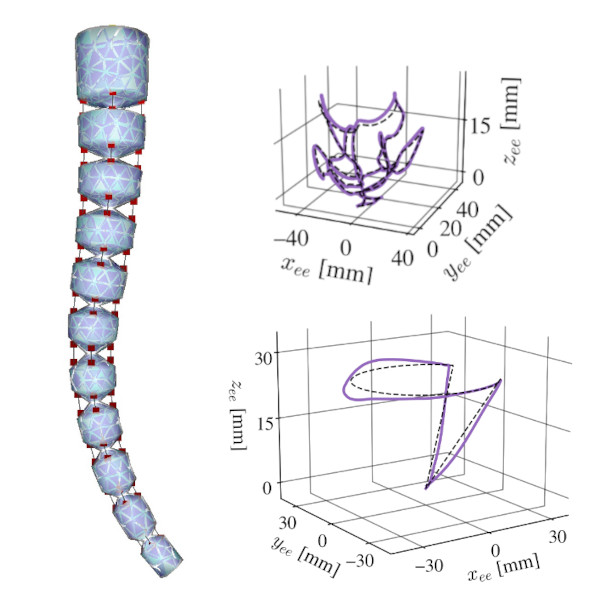 Data-Driven Soft Robot Control via Adiabatic Spectral SubmanifoldsThe International Journal of Robotics Research, Jul 2026
The mechanical complexity of soft robots creates significant challenges for their model-based control. Specifically, linear data-driven models have struggled to control soft robots on complex, spatially extended paths that explore regions with significant nonlinear behavior. To account for these nonlinearities, we develop here a model-predictive control strategy based on the recent theory of adiabatic spectral submanifolds (aSSMs). This theory is applicable because the internal vibrations of heavily overdamped robots decay at a speed that is much faster than the desired speed of the robot along its intended path. In that case, low-dimensional attracting invariant manifolds (aSSMs) emanate from the path and carry the dominant dynamics of the robot. Aided by this recent theory, we devise an aSSM-based model-predictive control scheme purely from data. We demonstrate the effectiveness of this data-driven model on various dynamic trajectory tracking tasks on a high-fidelity and high-dimensional finite-element model of a soft trunk robot. Notably, we find that four- or five-dimensional aSSM-reduced models outperform the tracking performance of other data-driven modeling methods by a factor up to 10 across all closed-loop control tasks.
@article{kaundinyaDatadrivenSoftRobot2026, title = {Data-Driven Soft Robot Control via Adiabatic Spectral Submanifolds}, author = {Kaundinya, Roshan S. and Alora, John Irvin and Matt, Jonas G. and Pabon, Luis A. and Pavone, Marco and Haller, George}, year = {2026}, month = jul, journal = {The International Journal of Robotics Research}, doi = {10.1177/02783649261461630} } A Welfarist Perspective on Fair Generation CurtailmentarXiv preprint 2605.03860, May 2026
@misc{mattWelfaristPerspectiveFair2026, title = {A {{Welfarist Perspective}} on {{Fair Generation Curtailment}}}, author = {Matt, Jonas G. and Shilov, Ilia and Bolognani, Saverio}, year = {2026}, month = may, number = {arXiv:2605.03860}, eprint = {2605.03860}, primaryclass = {eess}, publisher = {arXiv}, doi = {10.48550/arXiv.2605.03860}, archiveprefix = {arXiv} }